In the past weeks, you may have been lucky enough to have witnessed one of the brilliant displays of the aurora borealis in the night sky over Wester Ross. If you missed it, don’t despair. Sightings of the Northern Lights are on the rise. To find out why, we’ve asked Dr. Alec MacKinnon, professor of Astrophysics at Glasgow University and lecturer at last year’s Dark Skies Festival in Gairloch, what is behind the increase in activity…
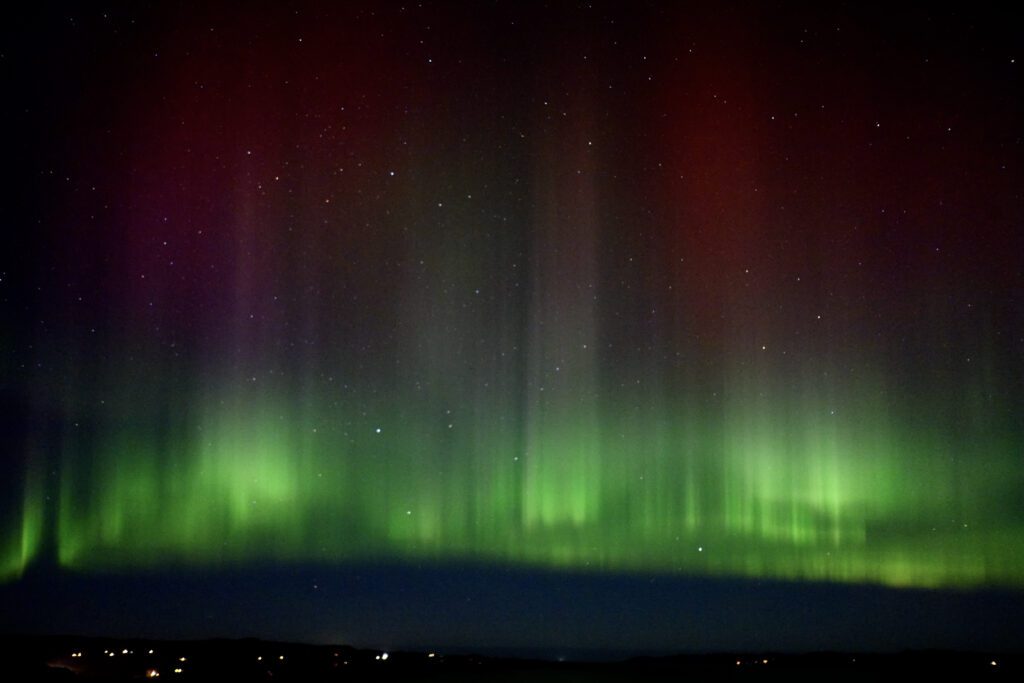
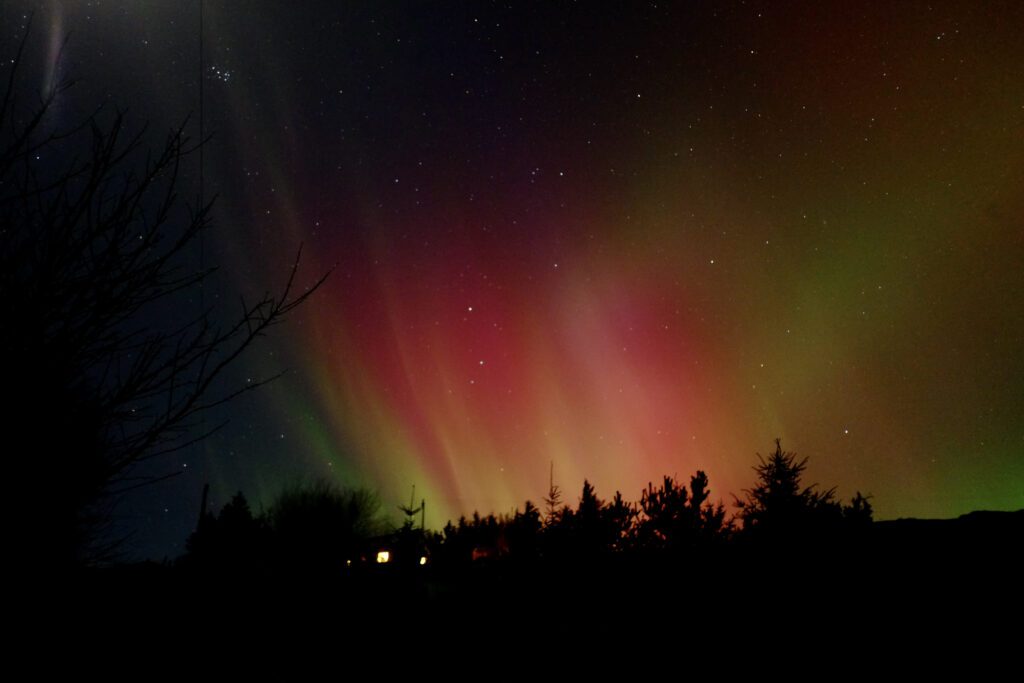
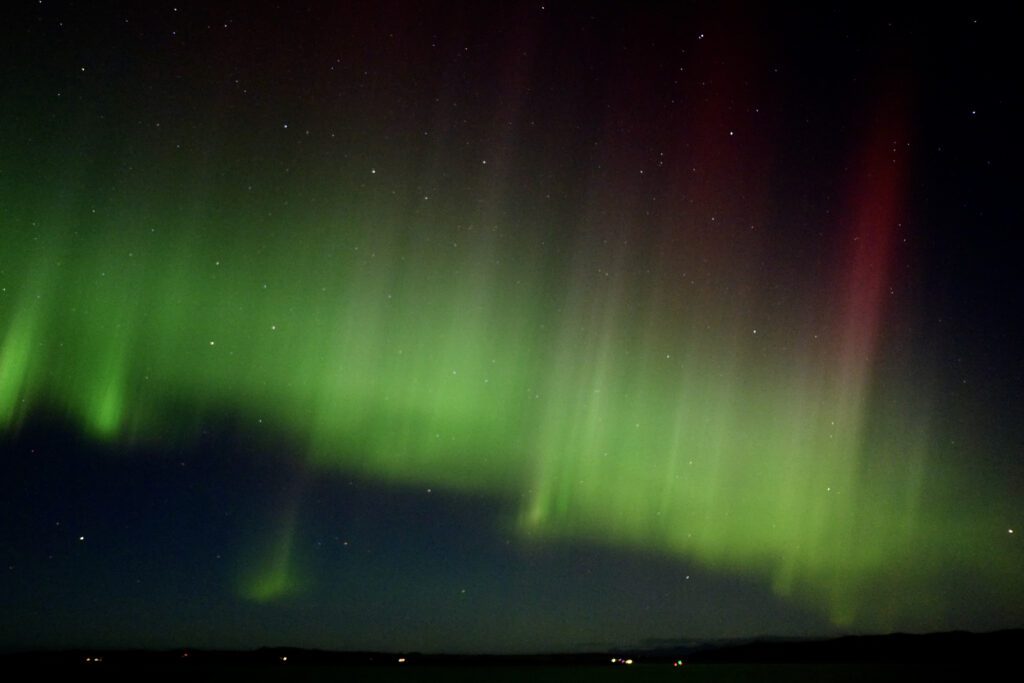
Northern Lights over Loch Ewe. Image courtesy of Simon Spare.
GALE:
Dr. MacKinnon, recently the residents of Gairloch and the surrounding area (as well as other parts of the UK) were treated to a dazzling show of the Northern Lights. We’ve read that we are currently in a sun cycle that will cause the aurora borealis to appear more often. What exactly is this cycle? What causes the Northern Lights exactly? And why do our cameras see the colours better than our eyes?
Dr. Alec MacKinnon:
You’re very lucky up there to have such dark skies. In the central belt here, all but the biggest aurorae are lost in urban light pollution. Nonetheless I’ve seen the aurora a couple of times and it’s a beautiful sight. I’m envious of the views you must have had.

This picture is of the Sun around the time those aurorae were happening. It was taken by an instrument on the NASA Solar Dynamics Observatory spacecraft which has a pretty much uninterrupted view of the Sun. It shows several sunspots, patches on the Sun’s visible disk that look dark because they are cooler than their surroundings. People have known about these sunspots for millennia but they can now be studied in great detail with modern telescopes and satellites.
There are not always sunspots. In fact the number of these goes up and down fairly regularly, on a cycle of roughly eleven years. At the minimum of this cycle the Sun may be spotless for weeks at a time. The number of spots increases for about the next five years, then falls away again over the next six before the cycle repeats again.
While you should never look directly at the Sun through a telescope or binoculars, you can use these devices to project an image of the Sun and view sunspots for yourself: (39) Make a Safe Sun Projector with Binoculars – YouTube
The gas of the Sun is in the state called “plasma”. It is at such a high temperature that collisions between atoms involve enough energy to knock electrons out of atoms. The constituents of the gas are electrically charged ions and electrons, rather than the neutral atoms we find almost everywhere here on Earth, and electrical and magnetic fields can play roles in how it behaves and what it can do. Sunspots mark places where the magnetic field is particularly strong. The magnetic field stops the hot gas underneath from rising and falling freely so the sunspot is cooler than its surroundings, appearing dark.
So the sunspot cycle, that has been known for a couple of centuries, is really a cycle in the magnetism of the Sun.
The magnetic field is responsible for all sorts of other phenomena, in particular explosions called solar flares, when patches of the surface brighten up suddenly. Often clouds of gas, accompanied by magnetic field, get ejected from the Sun into the rest of the solar system. You will often see these referred to as Coronal Mass Ejections or “CME’s”. Travelling at 500 to 3000 km per second these take 12 hours to a few days to arrive here – if they were ejected in the right direction. If they do arrive here they can trigger explosive events in the magnetic field in near-Earth space, leading to displays of the aurora. Some more details of how this happens are in this blog post Are the northern lights caused by ‘particles from the Sun’? Not exactly (theconversation.com).
So: the events that drive the aurora start at the Sun, their frequency coming and going with the sunspot cycle. At the moment we’re in the rising phase of the cycle, with maximum expected around July 2025, so there should be more opportunities to see them over the next few years. The whole topic of “space weather” is more and more important for satellite operations and even for electronic devices on the ground so there’s significant effort devoted to watching the Sun for CME’s. The major events in October 2003 were an example, resulting in spectacular displays of the aurora that were seen all over Britain and were easily bright enough for us to enjoy in the suburbs of a big city ESA – Impact of a solar storm, 28 October 2003.
We see Northern Lights when energetic electrons and ions are funnelled by Earth’s magnetic field downwards towards the polar regions, hitting the atmosphere high up and causing the atoms of the air to glow, a little bit like the glow in a fluorescent tube. If the aurora is a weak one the glow is too faint for your eye to detect the colours and you just see a sort of colourless glow near the northern horizon. I think people in dark parts of the country probably see them more often than they realise and just wonder if they were car headlights on a distant road or similar.
Digital cameras are amazingly sensitive. It’s not hard to take a photo of the night sky that shows stars fainter than those your eyes can perceive. Also the camera can add up all the light emitted in, say 10 or 20 seconds, which your eye/brain combination can’t do. So the sensitivity of the digital sensors and the ease of making time exposures combine to give brighter images with more pronounced colours than you see with your eye.
Thank you, Dr. MacKinnon, for your insight! As always, it’s been fascinating. The Dark Skies Festival will be returning to Gairloch in November 2023. For more information, visit the Wester Ross Biosphere website.
And if you fancy a little stargazing yourself, why not check out these books from the GALE Centre gift shop to help you identify the planets and constellations: