Welcome to our series of blogs where we have the opportunity to engage in conversation with Dr Alec MacKinnon, a renowned astrophysicist from the Department of Astrophysics at Glasgow University. It is a pleasure to have Dr MacKinnon with us as we delve into the fascinating world of astrophysics and explore the mysteries of the universe. In the lead up to the Wester Ross Biosphere Dark Skies event we will post weekly – so make sure to come back.
Dr MacKinnon will share his expertise, insights, and opinions on several topics, providing us with a deeper understanding of the universe we inhabit. So, sit back, relax, and join us on this journey of discovery as we explore the wonders of the cosmos with Dr Alec MacKinnon.
GALE:
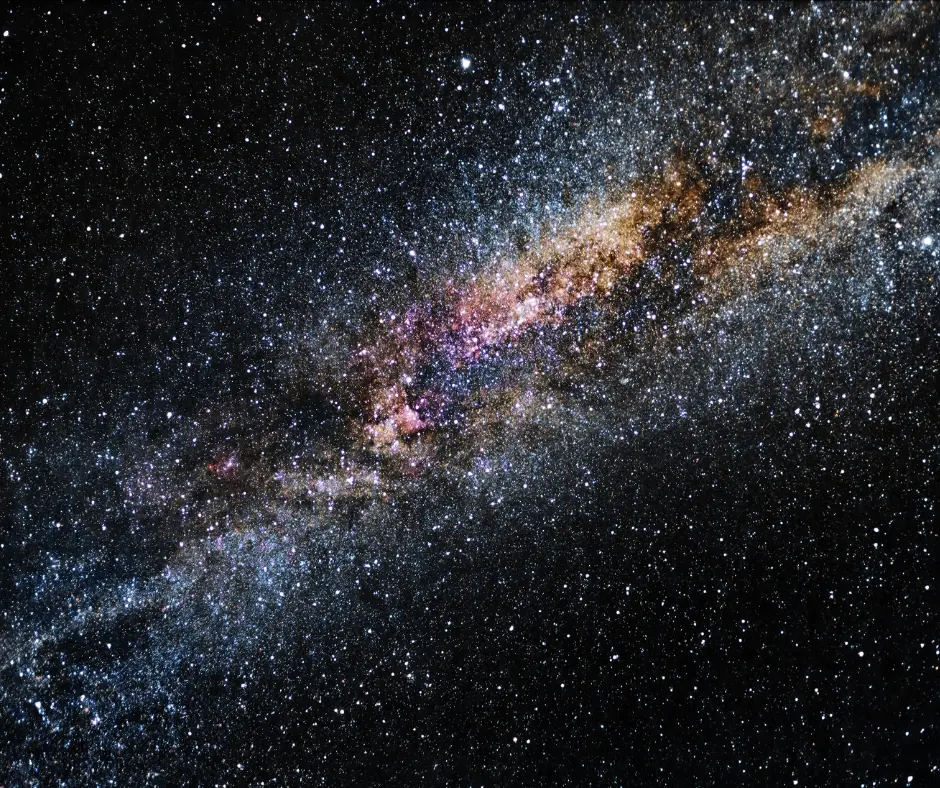
During your talk last year at the Dark Skies Festival in Gairloch, you spoke about why the night sky is dark when there are trillions of stars in the universe. The estimated number of stars is something inconceivable – like about 200 billion trillion. With that many stars, you’d think the whole sky would be filled with starlight. But that isn’t so. For those who missed your talk, could you briefly explain why the night sky is dark?
Dr Alec MacKinnon:
I think I’ll start by rewording the question slightly. There is indeed an enormous number of stars in the Universe. As long as it’s a finite number we could always imagine them spread out so sparsely that they still appear as individual points of light. We just have to make the universe big enough.
The Paradox
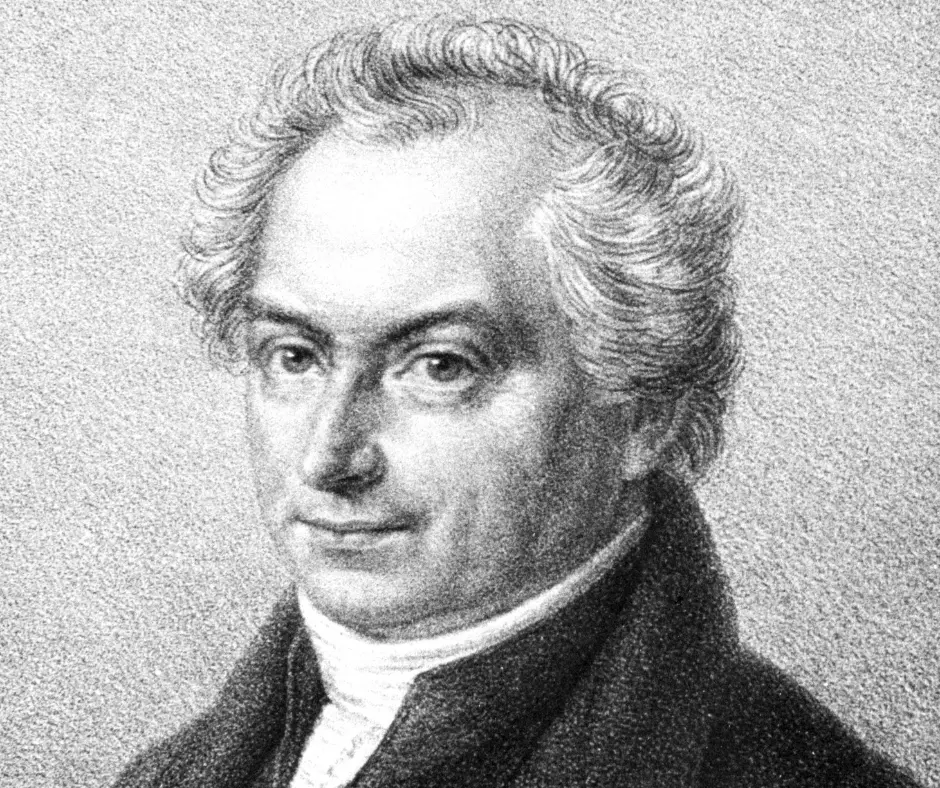
But if we start by supposing, as people did at one time, that the Universe is infinite and has stars scattered evenly everywhere, then every direction we look in will eventually lead to a star and the sky should be uniformly bright all over. Of course it isn’t. The night sky is mostly dark, with stars scattered across it. That it isn’t uniformly bright tells us that the initial supposition must be wrong in some way. This problem is known as Olbers’ Paradox after an 18th century German astronomer, although he wasn’t the first person to think about it.
Heinrich Olbers 1758 - 1840
Olbers himself believed that more distant stars might be hidden by dark material in space, as did the great Glasgow physicist Lord Kelvin. This explanation doesn’t work, however, because the sustained action of starlight on the dark material would cause it to heat up until it glowed as brightly as the stars it would have hidden.
The Explanation
The Universe is expanding, a fact first established in the 1920s by Edwin Hubble and others, by studying the distances and motions of the other galaxies. If we follow its present expansion backwards in time we’re forced to conclude that it came into existence at a finite time in the past: the so-called Big Bang. The current best estimate places this singular event at 13.8 billion years ago. Combining the finite age of the Universe with the finite speed of light leads to the modern resolution of Olbers’ Paradox.
Imagine we look out at the star-filled Universe and for now let’s suppose that it does indeed continue indefinitely. We don’t see infinitely far, however. As we think of stars further and further away it becomes more and more likely that they will be hidden behind nearer stars. We only see the stars within a comparatively nearby region. We can estimate the size of this region: the average volume occupied by a single star, divided by the cross-sectional area of a single star.
We can use the diameter of the Sun, 1,400,000 km as the size of a typical star. The spacing of stars in the Sun’s neighbourhood gives us an estimate of the average volume occupied by a star – about 100 cubic light years. (A light year is the distance light travels in a year, about 9 million million km). We find then that the Universe will become more or less opaque at a distance of about 13 million billion light years. But the Universe is only 13.8 billion years old so. The night sky is dark because the light from most stars has not yet had time to reach us. As Edgar Allan Poe, no less, wrote in 1848: ‘The only way we could comprehend the voids which our telescopes find in innumerable directions, would be by supposing the distance of the invisible background so immense that no ray from it has yet been able to reach us at all.’
However the modern science that gives us an age for the Universe also involve the discovery that the sky is indeed uniformly illuminated – just not in the visible light our eyes perceive. Microwaves are short wavelength radio waves, the sort used for mobile phones, radar, etc. Telescopes detecting microwaves find that the whole of the sky glows uniformly, the glow from the time when the expanding, cooling Universe first became transparent. This discovery was made by accident in 1968, a dramatic vindication of the idea of the Big Bang. As we look further and further away we look further and further back in time and this is the point we can’t see past. No stars had yet formed, though, this is a different sort of sky glow from that envisaged in Olbers’ Paradox.
So asking the question, ‘why is the sky dark at night?’ leads us to very basic questions about the Universe, its size and age.
Thank you, Dr. MacKinnon, for your insight! As always, it’s been fascinating. The Dark Skies Festival will be returning to Gairloch in November 2023. For more information, visit the Wester Ross Biosphere website.
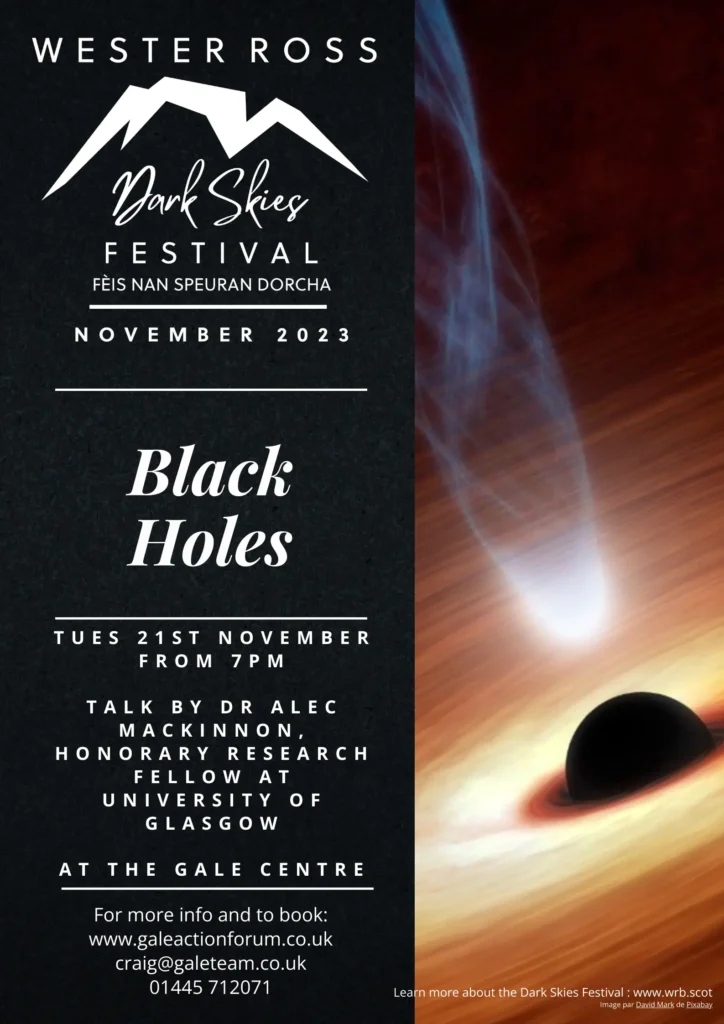
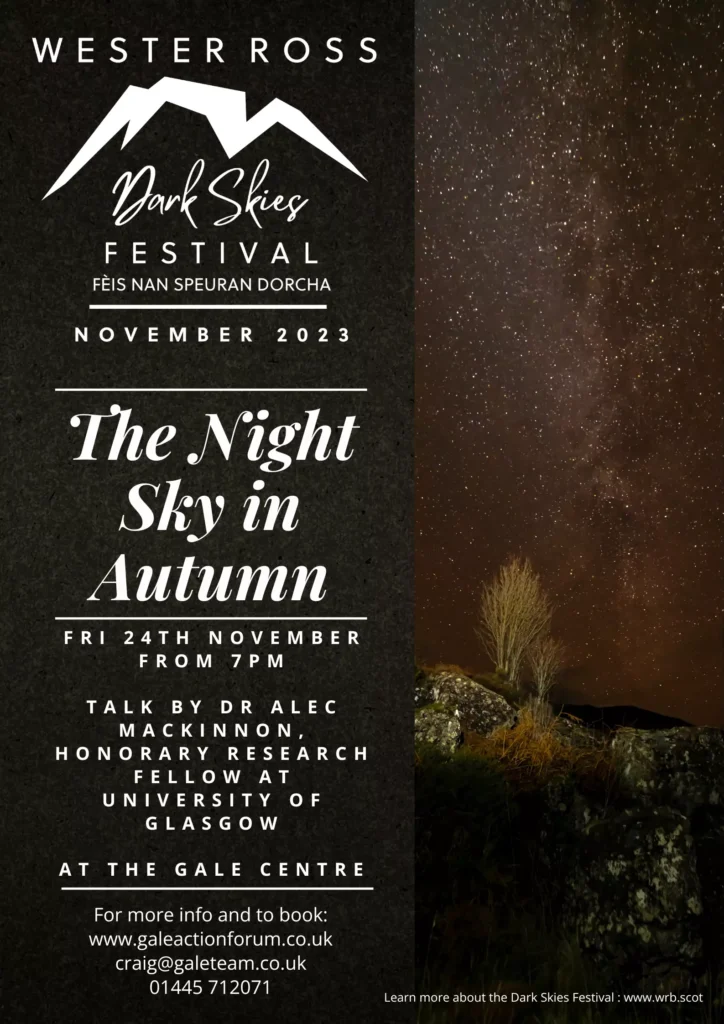
Dr MacKinnon will be at The GALE Centre in November with two lectures which are sure to enthral and entertain. Click on the images below for more details.
And if you fancy a little stargazing yourself, why not check out these books from the GALE Centre gift shop to help you identify the planets and constellations: